


Is It Still a Seller’s Market? What the 2025–2026 Housing Data Tells Buyers and Sellers

The frenzied seller’s market that defined real estate from 2020 to 2022 is no longer the national norm. Across much of the country, the balance of power between buyers and sellers has been quietly — but meaningfully — shifting. Understanding where things stand today isn’t just interesting context; it’s essential intelligence for anyone considering a move.
A Market in Transition
For a brief but memorable stretch, sellers held nearly unchallenged leverage. Buyers waived inspections, submitted offers well above asking price, and competed against dozens of others for a single home. That environment created a sense of urgency — and in many cases, desperation — that pushed market fundamentals to their limits.
That era is largely behind us.
According to data from Realtor.com, the national housing market is now balanced but gradually loosening, with conditions continuing to move in a more buyer-friendly direction. The shift is gradual rather than sudden, but its trajectory is consistent and measurable.
The clearest illustration of this change comes from Realtor.com’s analysis of the top 50 metro markets over time:
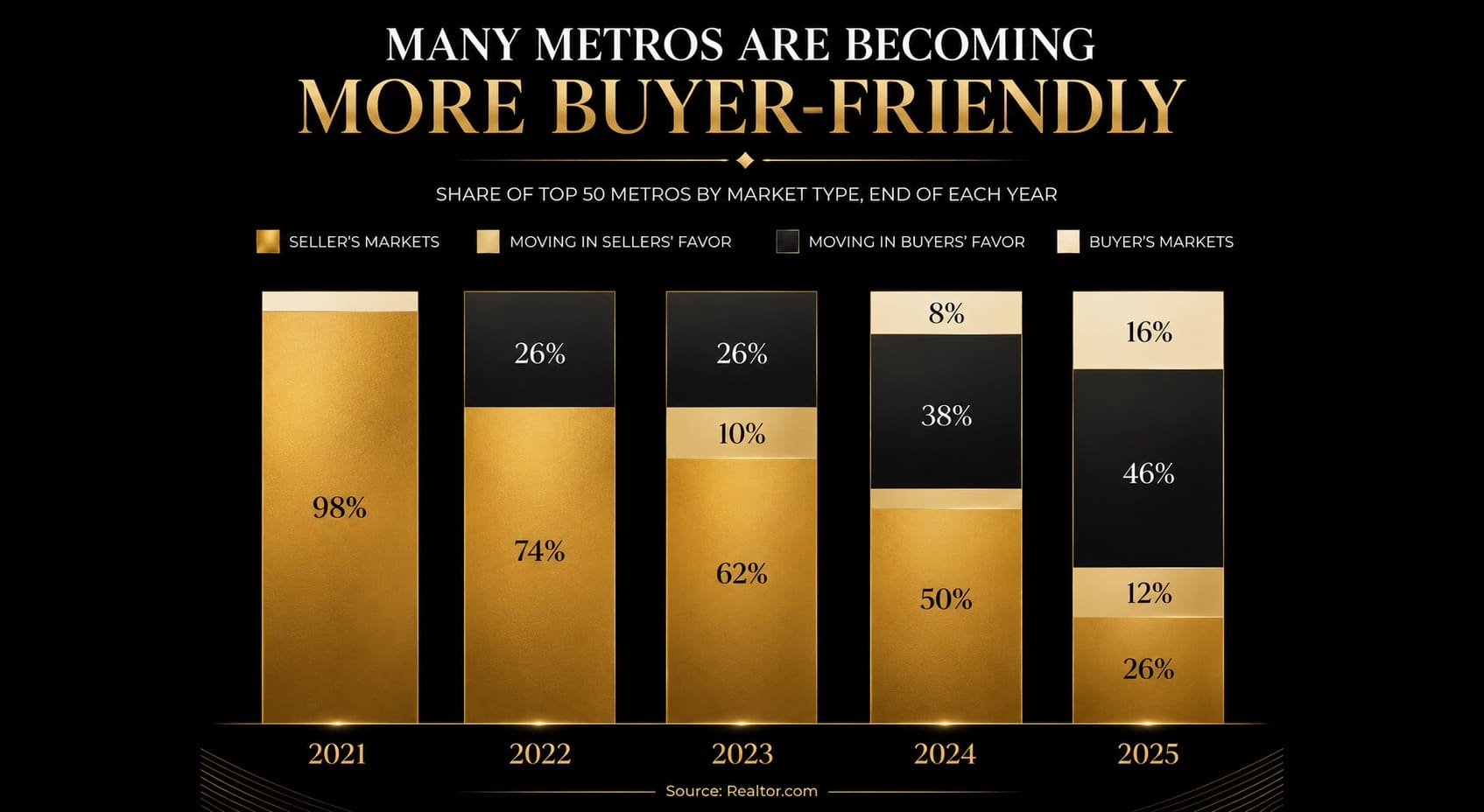
- In 2021, nearly all major metros across the country were classified as seller’s markets.
- By late 2025, only one in three of those same metros still favored sellers.
That’s a dramatic realignment in a relatively short period — and it has direct implications for how both buyers and sellers should approach today’s market.
Why the Shift Is Happening
The single biggest driver behind this change is inventory. During the pandemic era, a combination of historically low interest rates, remote work flexibility, and constrained housing supply created a perfect storm of demand against limited supply. Sellers had the upper hand almost everywhere.
Since then, inventory levels have climbed in many parts of the country — particularly in markets that experienced significant new construction activity. When more homes are available, buyers gain options, and with options come negotiating power.
As Jeff Ostrowski, Housing Analyst at Bankrate, explains: the formerly hot Sun Belt markets have cooled while the Northeast and Midwest have stayed competitive. The core reason is construction activity. Markets that saw major building booms now carry a larger supply of both new and existing homes, which has softened conditions for sellers in those areas.
The Local Picture: Not All Markets Are Equal
While the national trend leans toward greater balance, real estate remains a fundamentally local business. Where you live — and where you’re looking to buy or sell — matters enormously.
Sun Belt markets such as Austin, Tampa, and San Antonio experienced significant construction booms in recent years. That supply surge has translated into more choices for buyers, longer days on market for listings, and more room for price negotiation. Sellers in these areas need to reset their expectations accordingly.
Northeast and Midwest markets like Rochester, Hartford, and Buffalo tell a very different story. These areas did not see the same wave of new construction, which means inventory has remained constrained and competition has stayed fierce. Buyers in these markets are still navigating conditions that closely resemble the seller-favored environment of a few years ago.
The takeaway: before making any assumptions about your leverage — whether you’re buying or selling — understand the specific supply and demand dynamics in your target market.
What This Means if You’re Buying
If you’re purchasing a home in a market that still favors sellers, come prepared:
- Get pre-approved before you begin your search. A pre-approval letter signals financial readiness and seriousness to sellers who have multiple offers to consider.
- Be prepared to move quickly. Well-priced homes in low-inventory markets still attract strong interest. Delays can cost you the property.
- Think creatively about your offer terms. An aggressive price isn’t the only way to stand out. A flexible closing date, a larger earnest money deposit, or a streamlined contingency structure can be equally compelling.
- Work closely with your agent on offer strategy. In competitive markets, the difference between winning and losing often comes down to the details.
If you’re buying in a more balanced or buyer-friendly market, you have leverage — use it thoughtfully. You have more room to negotiate on price, request repairs, and take the time to make a well-considered decision.
What This Means if You’re Selling
If your local market has shifted toward buyers, the strategies that worked in 2021 won’t serve you well today. Sellers who haven’t adjusted their approach are finding out the hard way.
- Price your home accurately from day one. Overpricing is the most common and costly mistake sellers make in a softening market. A listing that sits too long signals problems to buyers — even if there aren’t any. Correct pricing generates interest; inflated pricing generates silence.
- Presentation matters more when competition is higher. With buyers having more options, curb appeal and home staging have a measurable impact on how quickly your home sells and at what price.
- Be open to offering incentives. Covering a portion of closing costs, including a home warranty, or accommodating the buyer’s preferred timeline can be the difference between closing a deal and watching it fall apart.
- Approach negotiations with flexibility. Buyers in today’s more balanced markets expect to negotiate. Sellers who dig in unnecessarily often end up in a worse position than those who engage constructively.
The Strategic Imperative: Know Your Market
The most important thing any buyer or seller can do right now is resist the temptation to rely on national headlines as a proxy for local conditions. The data tells a clear story at the macro level, but the ground-level reality in your specific market may look quite different.
A knowledgeable local agent is your most valuable resource for understanding current inventory levels, days-on-market trends, list-to-sale price ratios, and buyer or seller activity in your area. That intelligence is what shapes a winning strategy — whether you’re making an offer or accepting one.
The market has changed. The question is whether your approach has kept pace.
Ready to List Your Home?
Here’s How to Get Started.
If you’re considering selling, now is the time to move with intention — not hesitation. Today’s market still rewards well-positioned listings, but the margin for error is narrower than it was a few years ago. Pricing strategy, presentation, and timing all matter more.
We’re here to help you list your home with confidence.
Our team provides a comprehensive market analysis, professional listing strategy, and hands-on guidance from your first showing to the closing table. Whether you’re ready to list now or still weighing your options, the right conversation starts here.






Explore More Homes Throughout Tampa Bay
Not finding the perfect home in your preferred neighborhood? Expanding your search can open the door to more opportunities, better value, and additional inventory throughout the Tampa Bay area.
Browse Homes for Sale In:
Whether you’re looking for new construction, waterfront living, luxury homes, family-friendly communities, or more affordable options, these growing Tampa Bay neighborhoods offer something for every lifestyle and budget.
• New Tampa
• Riverview
• Apollo Beach
• Land O’ Lakes
• San Antonio
Need a customized home search? I can help you compare communities, identify the best opportunities, and find the right home based on your goals.
👉 Start your personalized home search today.

Elena Esquen, MBA
Realtor® & Broker Associate
New Construction Specialist & Relocation Expert
Coldwell Banker Realty
📱 Phone: 813-822-4261
✉️ Email: Homes@EsquenTampaBay.com
🌐 Website: EsquenTampaBay.com
🏠 Resources: TampaHomesToday.com
🌴 Serving the Greater Tampa Bay Area
Frequently Asked Questions
1. Is the housing market still a seller’s market in 2026?
It depends entirely on where you are. Nationally, the market has shifted toward greater balance, with only about 26% of the top 50 metros still classified as seller’s markets as of late 2025. However, markets in the Northeast and Midwest continue to favor sellers due to persistently low inventory. The best way to know where your local market stands is to consult a local real estate professional with access to current data.
2. What caused the housing market to shift away from sellers?
The primary driver is inventory growth. As new construction increased — particularly in Sun Belt markets like Austin, Tampa, and San Antonio — the supply of available homes rose, giving buyers more choices and more negotiating power. Rising mortgage rates also reduced buyer demand during this period, further contributing to the rebalancing.
3. Should I wait to buy a home until the market improves further?
Timing the market is rarely a reliable strategy. The right time to buy depends on your personal financial readiness, your long-term plans, and local conditions in your specific area. In many buyer-friendly markets, today’s conditions already offer meaningful advantages — more inventory, less competition, and room to negotiate. Waiting in hopes of a further shift carries its own risks, including potential interest rate changes.
4. Is it still worth selling my home in a buyer’s market?
Yes — with the right strategy. Homes that are priced correctly, presented well, and marketed professionally continue to sell in buyer-friendly markets. The difference is that sellers need to be more strategic than they were in 2021. Overpricing and minimal preparation are the two most common reasons listings fail in today’s environment.
5. How do I know which type of market I’m in?
Key indicators include days on market, list-to-sale price ratios, months of supply, and the ratio of active listings to pending sales. A local real estate agent can walk you through all of these metrics for your specific area and explain what they mean for your buying or selling strategy.
6. What is a “balanced” real estate market?
A balanced market is generally one where supply and demand are roughly equal — typically reflected by about 5 to 6 months of available housing inventory. In a balanced market, neither buyers nor sellers hold a significant advantage, and negotiations tend to be more straightforward and less emotionally charged.
Disclaimer
The information provided in this blog post is intended for general informational and educational purposes only. It does not constitute financial, legal, or real estate advice. Market conditions vary significantly by location and can change rapidly. Data referenced in this post is sourced from Realtor.com and Bankrate and reflects conditions as reported through early 2026. Readers are encouraged to consult a licensed real estate professional in their area before making any buying or selling decisions. Past market conditions are not indicative of future results.